Category: Research Post

  • Sexual health information needs and preferred communication channels for sexual and gender minority group members

    Sexual health information needs and preferred communication channels for sexual and gender minority group members

    About the Research

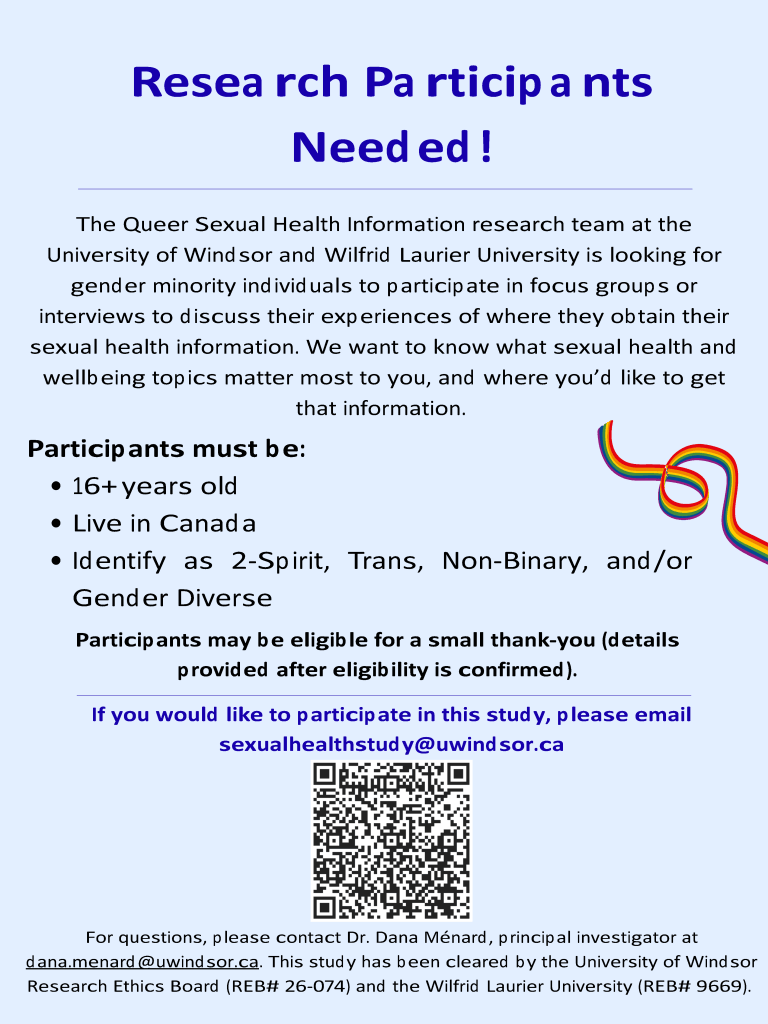
    We are recruiting individuals who identify as gender minority group members (e.g., transgender, non-binary, agender) to participate in focus groups or interviews on where they get their sexual health information and what their needs are in relation to their sexual health and wellbeing. The groups or interviews will take 1-2 hours to complete and will be online or in person, depending on participants’ preferences. Topics will include myths and misinformation in the community, current sexual health information needs, and preferred channels for receiving sexual health information.

    $50 gift card for participation.
    Please email sexualhealthstudy@uwindsor.ca to participate

    Researcher Contact

    Sophia D’Alonzo – She/Her
    Menard Psych Group

    Poster

  • Love Under Pressure

    Love Under Pressure

    Love Under Pressure

    About the Research

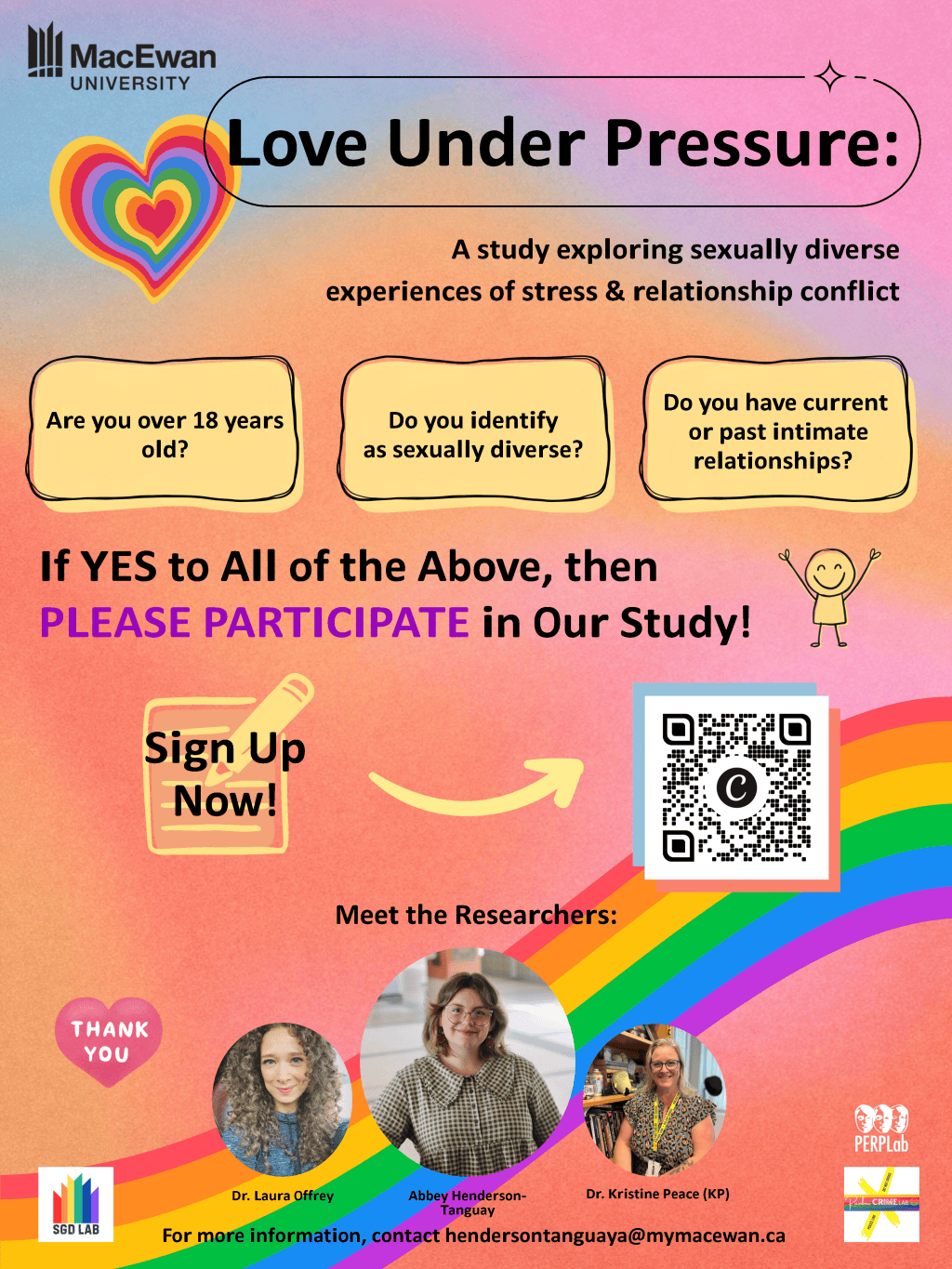
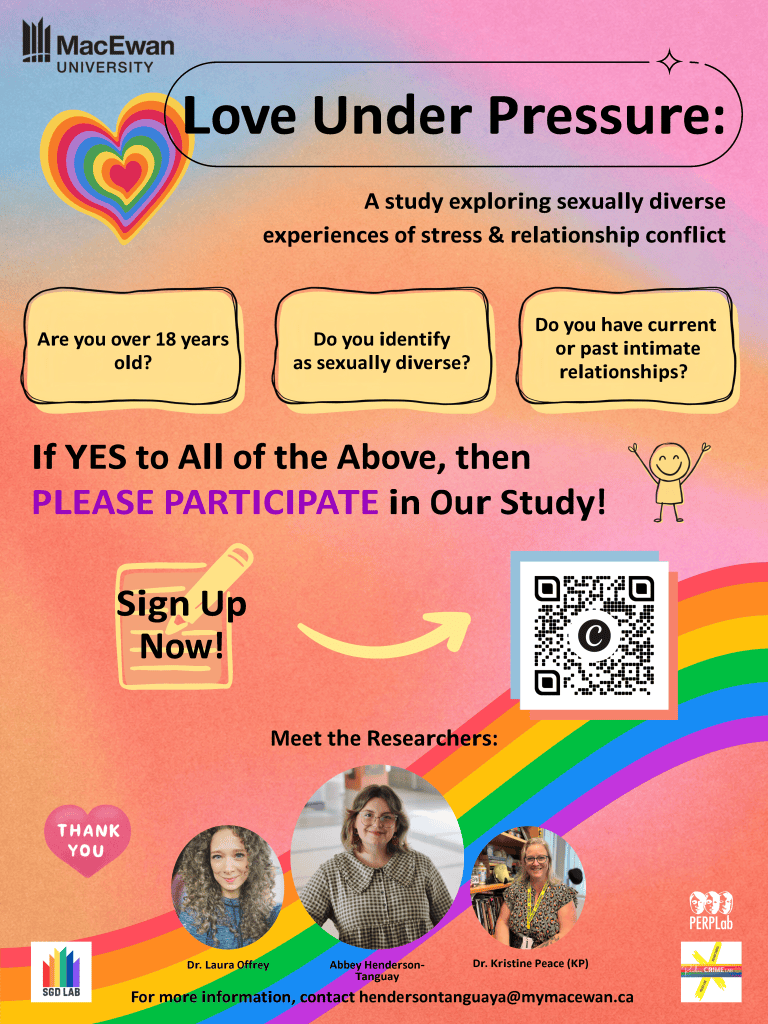
    The survey examines specific risk/protective factors that we predict will impact the relationship between sexual minority stress and Intimate Partner Violence outcomes. We hope to gain an inclusive, sexually diverse perspective on how stress impacts relationship health and violence. We are also hoping to gain information on factors that reduce stress and increase relationship health and non-violent behaviours. 
    https://macewanpsych.eu.qualtrics.com/jfe/form/SV_2hM4ffTIccugzKm

    Researcher Contact

    Abbey Henderson-Tanguay – She/Her
    MacEwan University
    hendersontanguaya@mymacewan.ca

    Poster

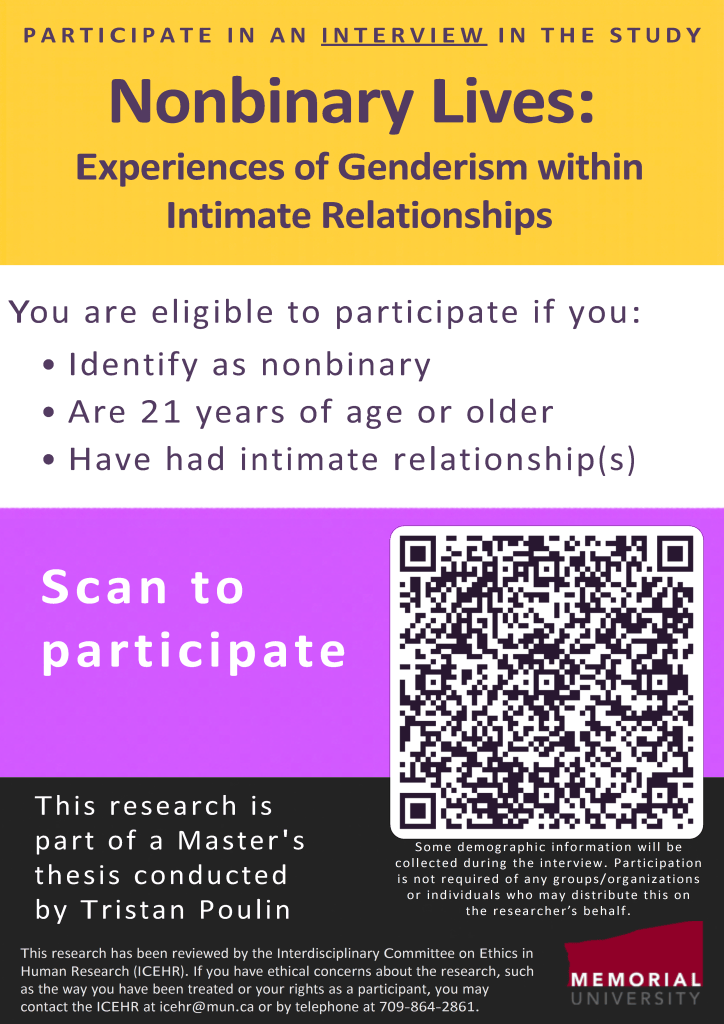
  • Nonbinary Lives: Experiences of Genderism within Intimate Relationships

    Nonbinary Lives: Experiences of Genderism within Intimate Relationships

    Nonbinary Lives: Experiences of Genderism within Intimate Relationships

    About the Research

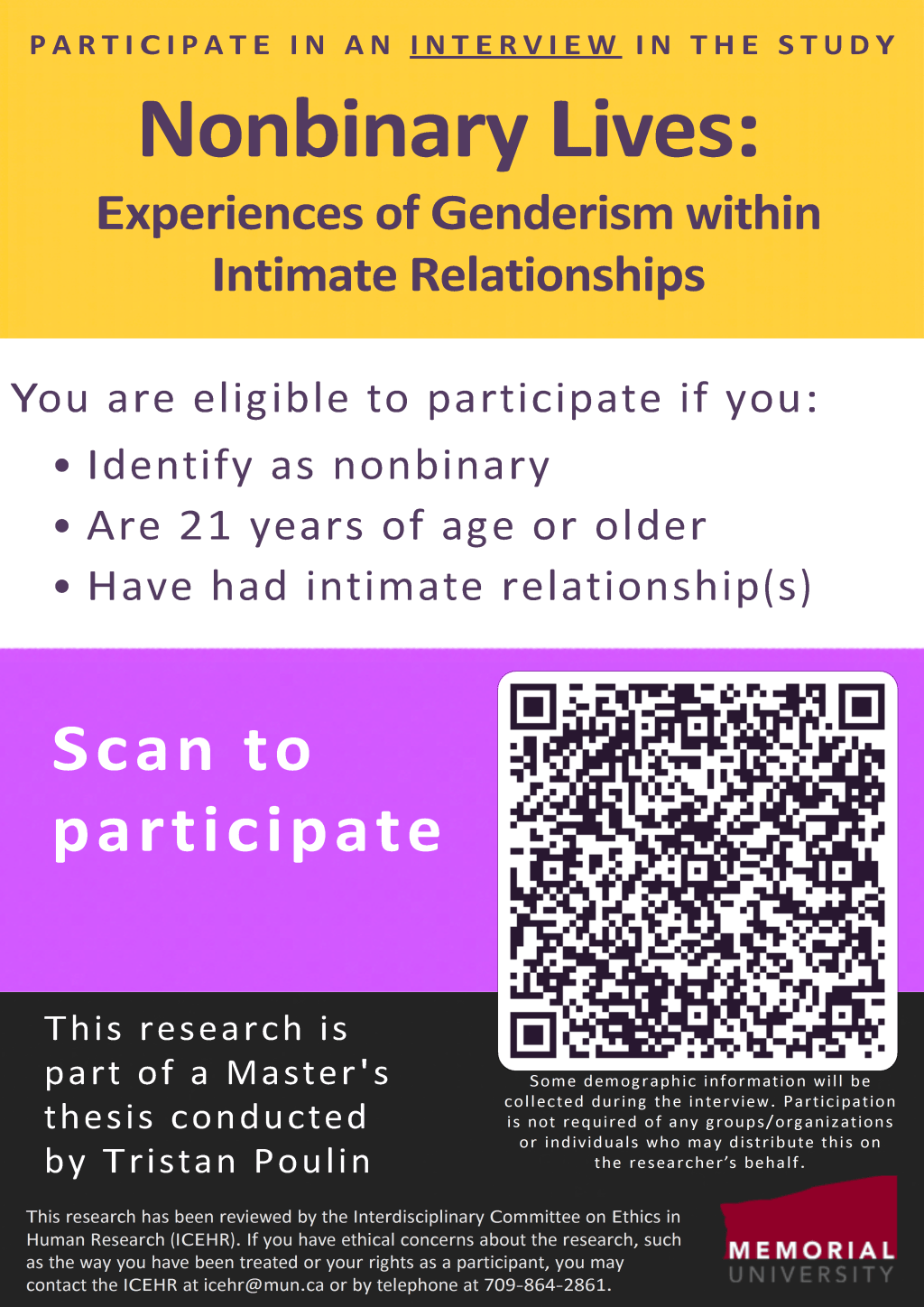
    The purpose of the study is to examine how nonbinary individuals navigate and negotiate binary gender norms within intimate relationships. You are invited to participate in an interview in which you will be asked to answer questions about your experience of rigid binary gender norms as a nonbinary person.
    https://forms.gle/7HNuBSUWN9GxEqmh6

    Researcher Contact

    Tristan Poulin – They/Them
    Memorial University of Newfoundland
    tpoulin@mun.ca

    Poster

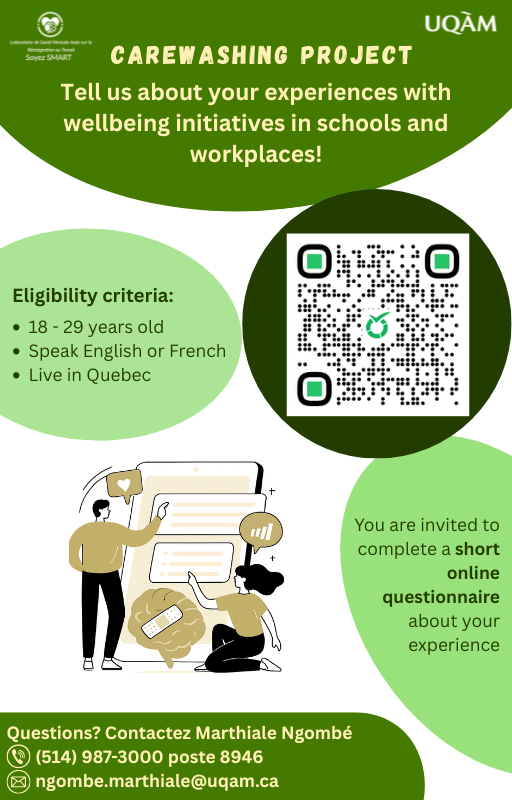
  • Carewashing Study

    Carewashing Study

    Carewashing Study

    About the Research

    The SMART Lab is working on a pilot study that examines students’ “carewashing” experiences. Similarly to “greenwashing”, carewashing refers to practices some organizations use to advertise their values of “care” for their employees without measurable effects. Our research lab invites individuals aged 18 to 29 to complete a 15 minute anonymous survey. This is a non-paid study. Thank you so much and we hope you have a great day!
    https://smart-researchlab.limesurvey.net/Carewashing?lang=en&newtest=Y 

    Researcher Contact

    Roseline Pagé – She/Her
    SMART Lab
    roseline.page@mail.mcgill.ca

    Marthiale Ngombé
    SMART Lab
    ngombe.marthiale@uqam.ca

    Poster

  • Sexual health information needs and preferred communication channels for sexual and gender minority group members

    Sexual health information needs and preferred communication channels for sexual and gender minority group members

    1. About the Research
    2. Link to Complete
    3. Researcher Contact
    4. Poster

    About the Research

    We are recruiting individuals who identify as gender minority group members (e.g., transgender, non-binary, agender) to participate in focus groups or interviews on where they get their sexual health information and what their needs are in relation to their sexual health and wellbeing. The focus groups or interviews will take 1-2 hours to complete and will be online or in person, depending on participants’ preferences. Topics will include myths and misinformation in the community, current sexual health information needs, and preferred channels for receiving sexual health information.

    Please email sexualhealthstudy@uwindsor.ca

    Researcher Contact

    Sophia D’Alonzo – She / Her
    The queer Sexual Health Information team sexualhealthstudy@uwindsor.ca

  • How to include gender diversity in quantitative research : how gender categories are produced and received

    How to include gender diversity in quantitative research : how gender categories are produced and received

    1. About the Research
    2. Link to Complete
    3. Researcher Contact
    4. Poster

    About the Research

    ⟶ What is my research about?

    My name is Marie (he/they), and I’m pursuing a PhD in France (EHESS) and in Quebec (UQAM). My thesis focuses on how research addresses the specific experiences of non-binary people. To that end, I’m conducting interviews with people who do not identify within binary gender categories.

    ⟶ Who can participate?

    Anyone living in Quebec who identifies on the non-binary spectrum—including people who are genderfluid, genderqueer, trans non-binary, Two-Spirit, agender… or who refuse to categorize their gender.

    ⟶ What in an interview?

    It’s a meeting—either remotely or at a location of your choice in Montreal (I know a few great places)—to chat for one to two hours about the terms you use, your relationship to gender, and the role of labels. Drinks are on me!

    The interviews are recorded using a voice recorder. They are anonymized and confidential. I use consent forms.

    ⟶ What’s the purpose?

    My work aims to improve the representation of trans and non-binary people in research, in order to implement public policies that are truly useful for our communities. In France, I hope to help improve survey questionnaires. In the Quebec context, I want to help develop analytical techniques that truly shed light on the realities and needs of trans and non-binary people.

    instagram : @recherche_nonbinarite

    Researcher Contact

    Marie Delahousse – They / Them
    marie.delahousse@ehess.fr
    10/23/2026

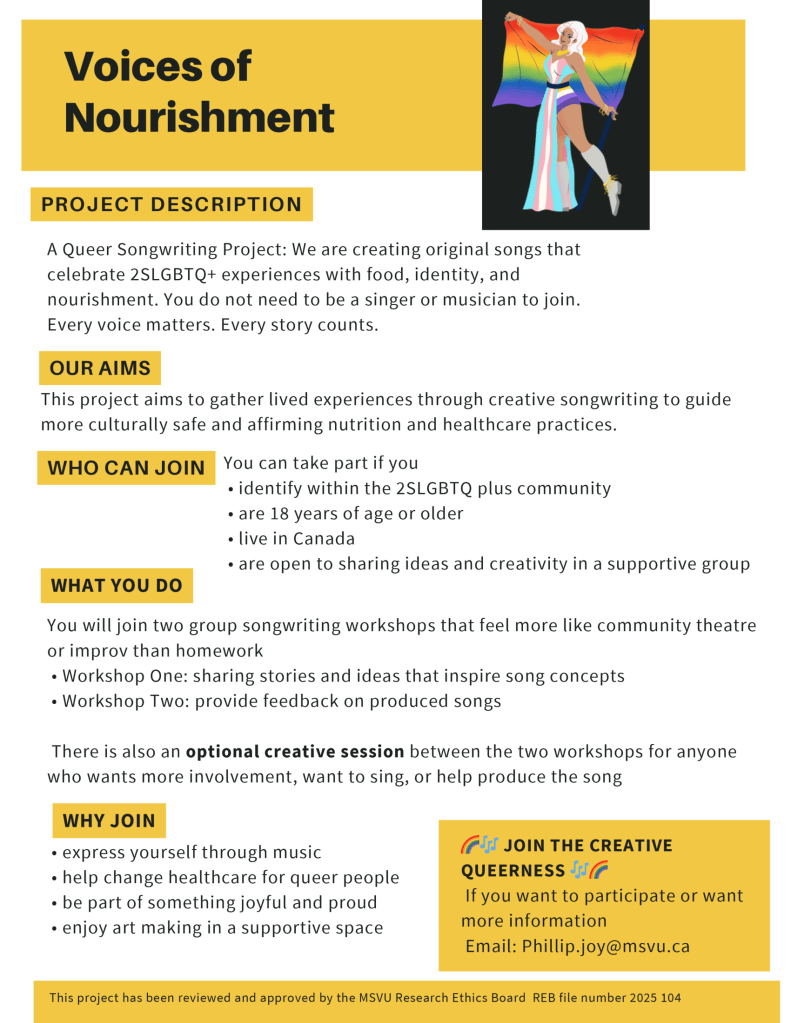
  • Voices of Nourishment: Developing Novel Curriculum Tools for 2SLGBTQ+ Cultural Safety

    Voices of Nourishment: Developing Novel Curriculum Tools for 2SLGBTQ+ Cultural Safety

    1. About the Research
    2. Link to Complete
    3. Researcher Contact
    4. Poster

    About the Research

    This study explores the lived experiences of 2SLGBTQ+ adults in Canada regarding nutrition, food, and identity through participatory songwriting. By engaging participants in reflective storytelling and collaborative music creation across two group workshops, the study aims to produce original songs that authentically reflect their personal narratives. Ultimately, the research hopes to use these creative outputs to co-create culturally safe and inclusive training modules for dietitians, thereby enhancing dietetic education and improving healthcare experiences for the 2SLGBTQ+ community.

    For questions or concerns about the study, contact: Dr. Phillip Joy at Phillip.joy@msvu.ca

    Researcher Contact

    Louis Pierre Côté – He / Him

    Mount Saint Vincent University

    louis.cote@msvu.ca

    Poster

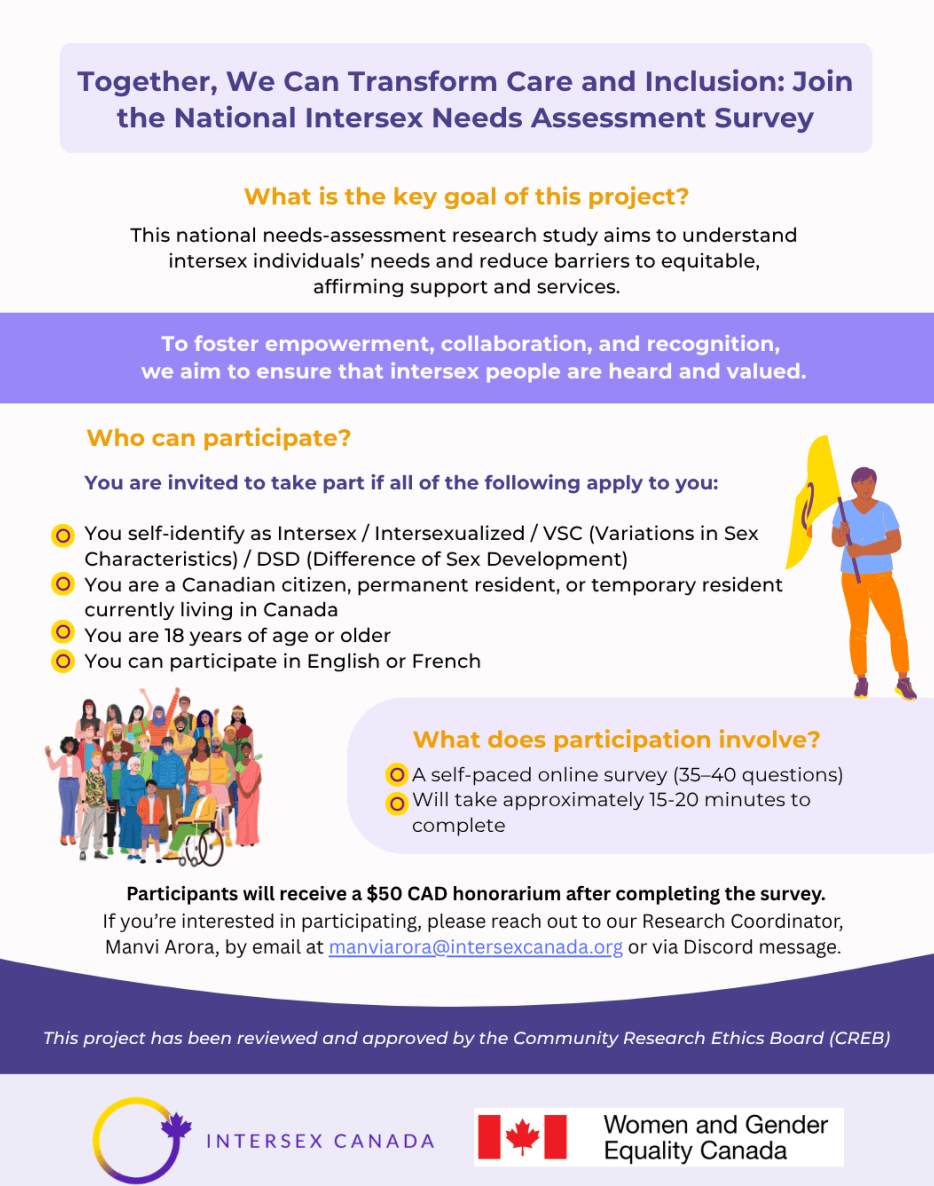
  • National Intersex Needs Assessment Survey

    National Intersex Needs Assessment Survey

    National Intersex Needs Assessment Survey

    About the Research

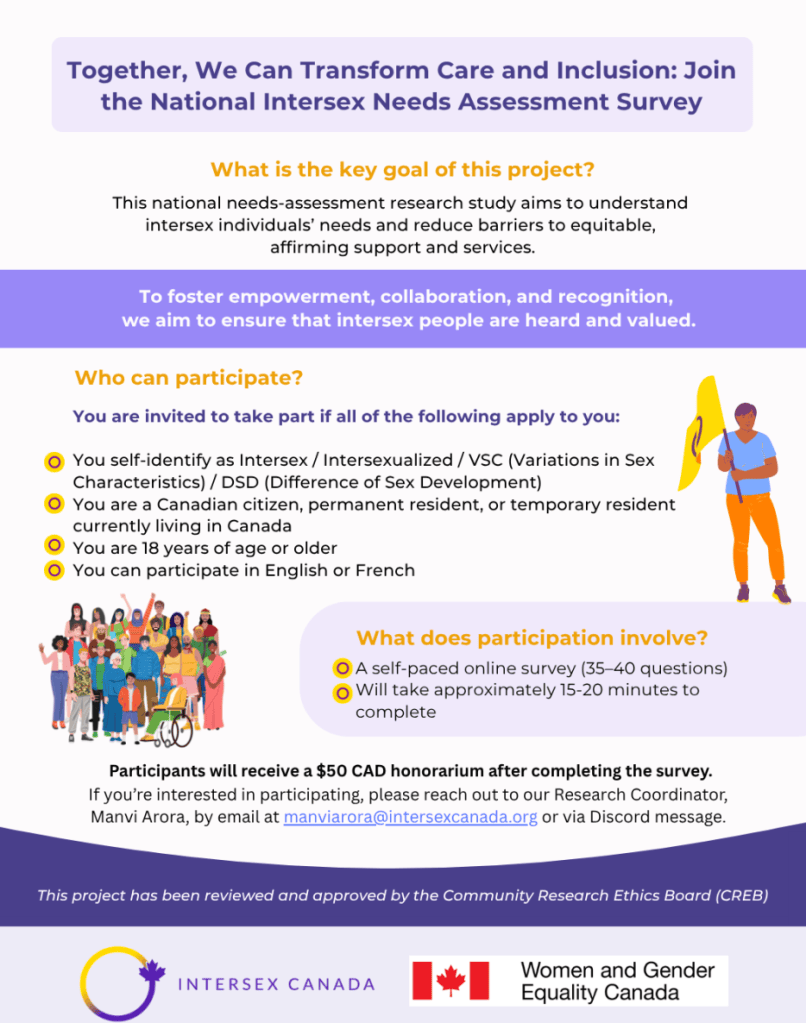
    Intersex Canada is inviting intersex people across the country to participate in one of the first community-driven national needs assessment surveys of its kind. For too long, intersex voices have been underrepresented in research, policy, and healthcare. By sharing your lived experiences, you can help:

    • Make intersex needs more visible

    • Improve access to supportive services

    • Strengthen knowledge among healthcare providers and decision-makers

    • Support advocacy efforts

    • Contribute to meaningful national change

    Contact below

    Researcher Contact

    Janille Giambattista – She / Her
    Intersex Canada
    janille@intersexcanada.org

    Poster

  • Piloting a brief, online intervention for suicidality in sexual and gender minority youth

    Piloting a brief, online intervention for suicidality in sexual and gender minority youth

    1. About the Research
    2. Link to Complete
    3. Researcher Contact
    4. Poster

    About the Research

    You are being invited to participate in a study investigating the effectiveness and acceptability of KindMind, an online program designed to help reduce suicidal thoughts in sexual and gender minority youth. In this study, you will be asked to complete an initial study session that will involve filling out questionnaires on mental health symptoms, such as depressive symptoms and suicidal thoughts and behaviours, and completing KindMind, a 20-minute online program. This session should take approximately 40 minutes. One month after this initial session, you will be asked to complete a follow-up survey that will take approximately 5-10 minutes. Your participation is completely voluntary, and all information collected is confidential.

    https://uwo.eu.qualtrics.com/jfe/form/SV_820F4Cgv34EXBv8

    Researcher Contact

    Genny Bianchini

    She / Her
    gbianch2@uwo.ca

  • A Study Exploring Experiences of Contact Following Unwanted Sexual Experiences

    A Study Exploring Experiences of Contact Following Unwanted Sexual Experiences

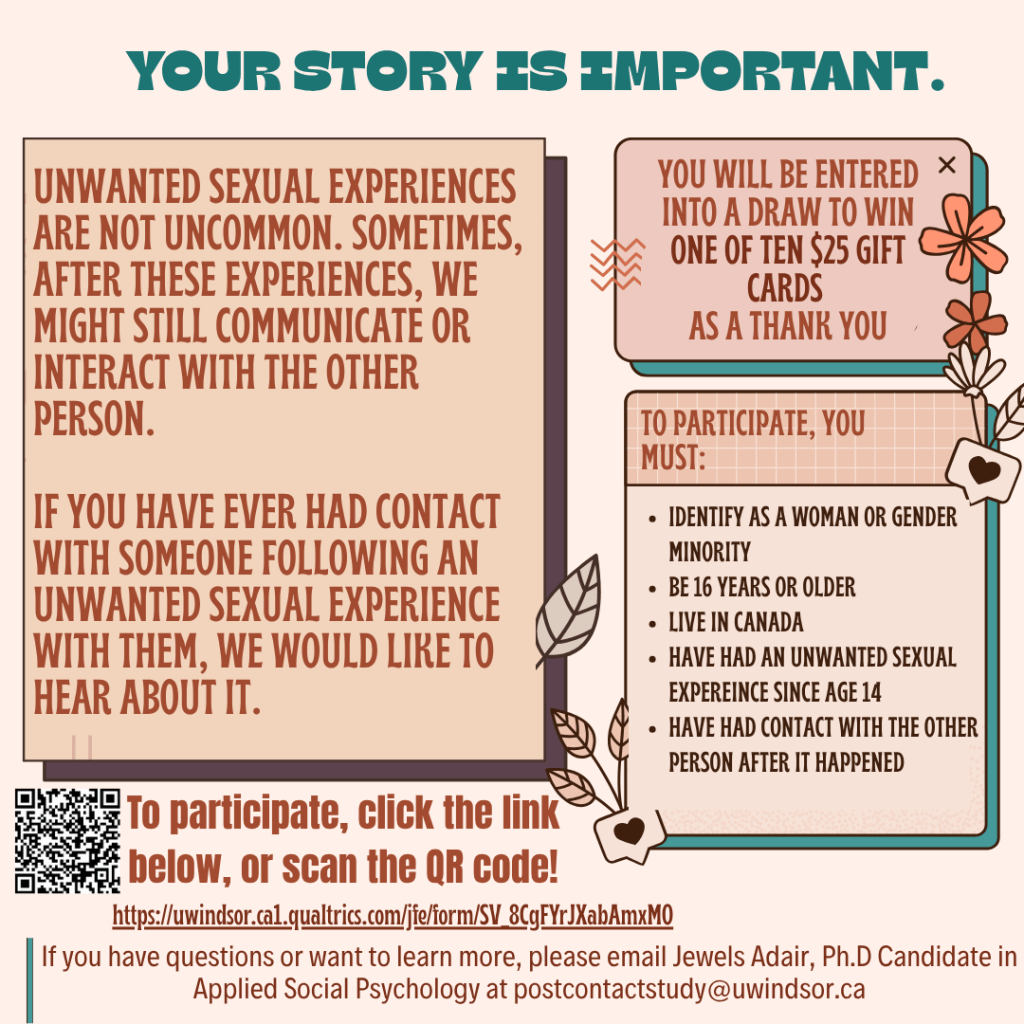
    The purpose of this study is to centre survivors’ voices in an area that has often been overlooked in research, specifically, what happens after an unwanted sexual experience when there is continued interaction with the person involved.

    This study involves both a survey and interview. Once participants fill out the survey, they can indicate if they are interested in participating in a follow-up interview. If they are, we will reach out to them to see if they are still interested, and set up an interview date that works for them.

    In summary, our study seeks to understand what happens after an unwanted sexual experience when individuals have communication or contact with the person involved, specifically from the survivor’s lived experiences. It examines how perpetrators respond in these interactions (e.g., denial, minimization, blame), how survivors interpret and make sense of these responses, and how these interactions affect their well-being.
    We also aim to explore how broader social narratives and power dynamics may shape these interactions, with the goal of developing a more comprehensive and survivor-centred understanding of post-assault experiences.

    Link to Complete the Survey

    Contact:
    Jewels Adair
    University of Windsor
    Sher / Her
    adair3@uwindsor.ca