Tag: Mental Health

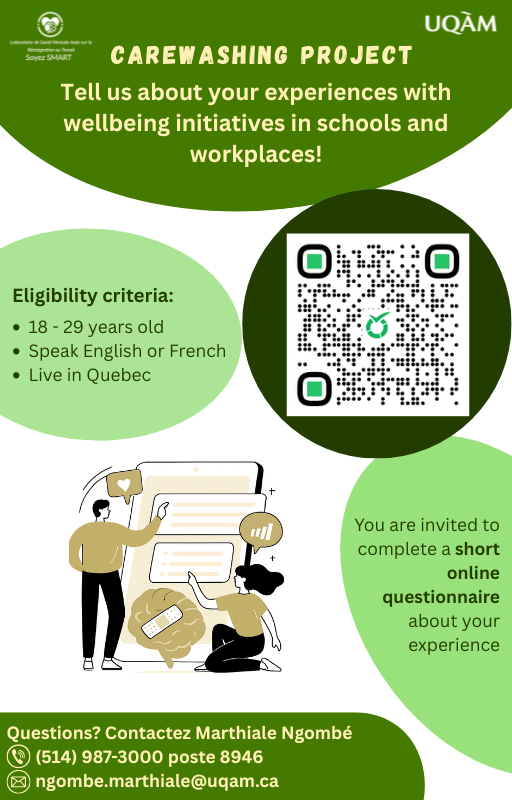
  • Carewashing Study

    Carewashing Study

    Carewashing Study

    About the Research

    The SMART Lab is working on a pilot study that examines students’ “carewashing” experiences. Similarly to “greenwashing”, carewashing refers to practices some organizations use to advertise their values of “care” for their employees without measurable effects. Our research lab invites individuals aged 18 to 29 to complete a 15 minute anonymous survey. This is a non-paid study. Thank you so much and we hope you have a great day!
    https://smart-researchlab.limesurvey.net/Carewashing?lang=en&newtest=Y 

    Researcher Contact

    Roseline Pagé – She/Her
    SMART Lab
    roseline.page@mail.mcgill.ca

    Marthiale Ngombé
    SMART Lab
    ngombe.marthiale@uqam.ca

    Poster
  • National Intersex Needs Assessment Survey

    National Intersex Needs Assessment Survey

    National Intersex Needs Assessment Survey

    About the Research

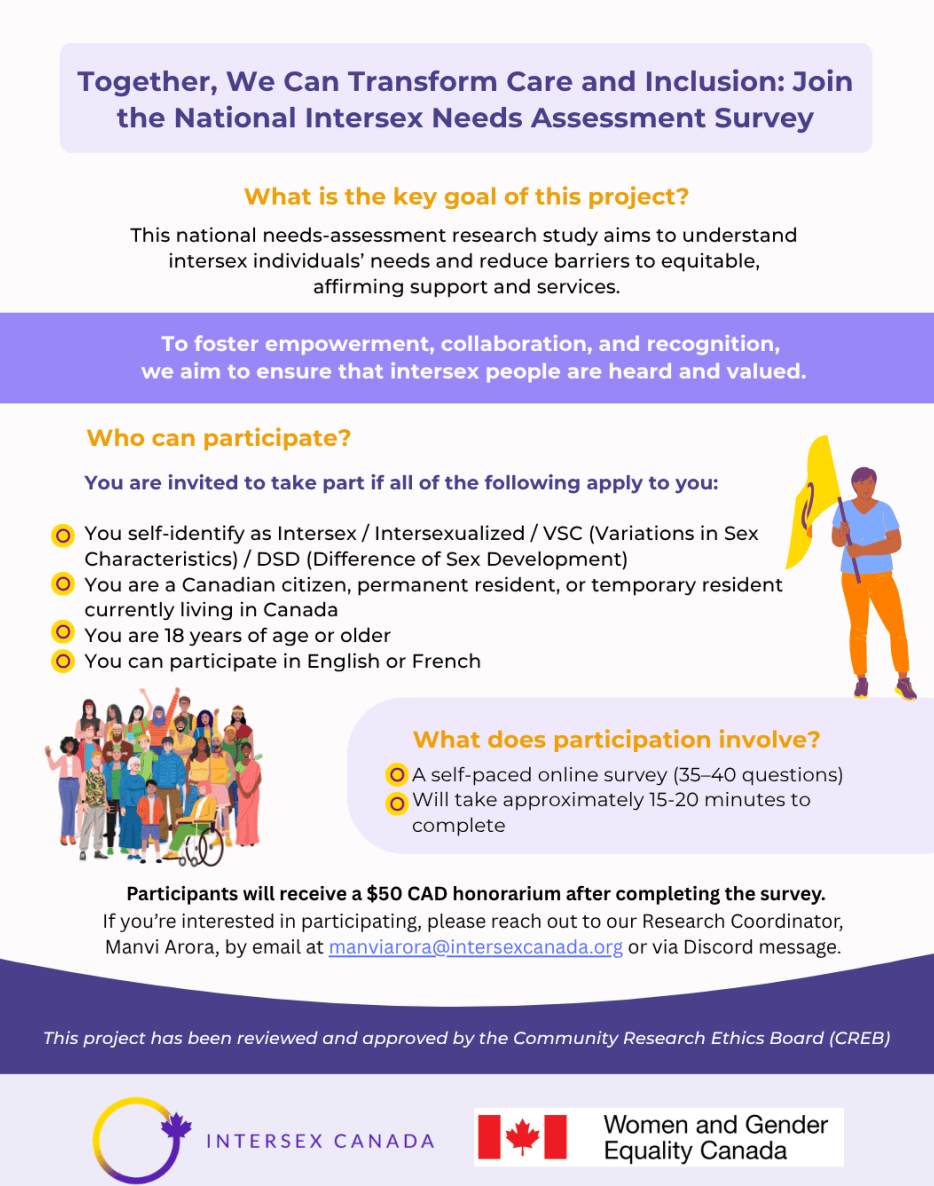
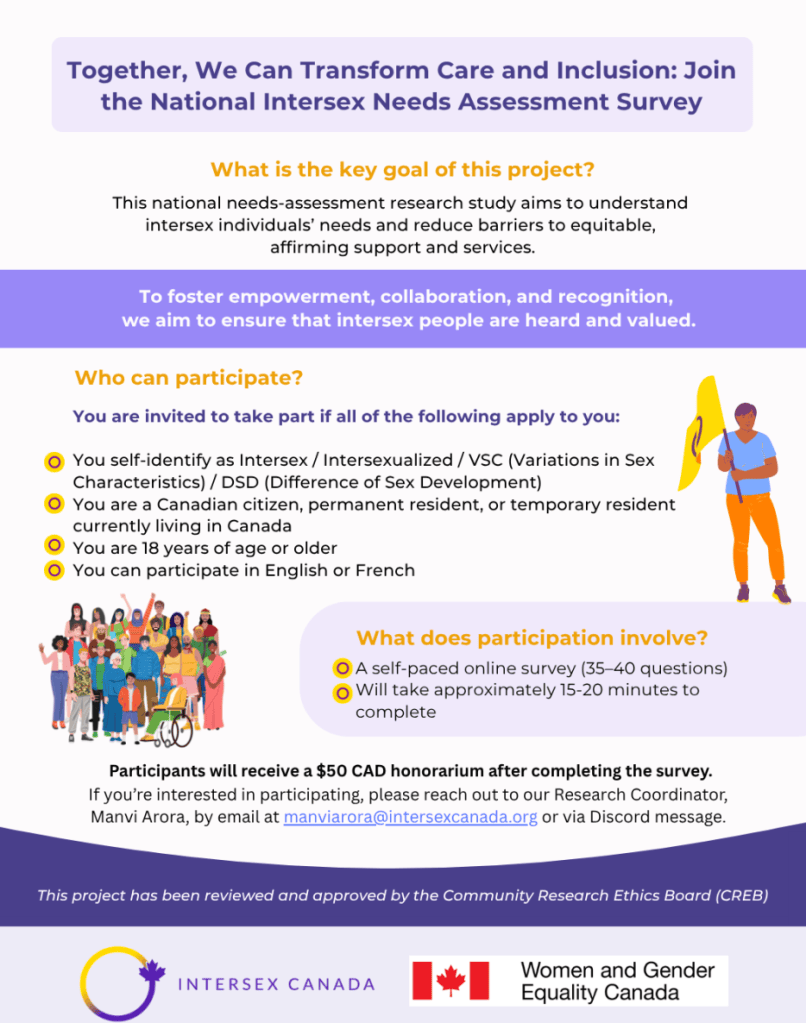
    Intersex Canada is inviting intersex people across the country to participate in one of the first community-driven national needs assessment surveys of its kind. For too long, intersex voices have been underrepresented in research, policy, and healthcare. By sharing your lived experiences, you can help:

    • Make intersex needs more visible

    • Improve access to supportive services

    • Strengthen knowledge among healthcare providers and decision-makers

    • Support advocacy efforts

    • Contribute to meaningful national change

    Contact below

    Researcher Contact

    Janille Giambattista – She / Her
    Intersex Canada
    janille@intersexcanada.org

    Poster

  • Piloting a brief, online intervention for suicidality in sexual and gender minority youth

    Piloting a brief, online intervention for suicidality in sexual and gender minority youth

    1. About the Research
    2. Link to Complete
    3. Researcher Contact
    4. Poster

    About the Research

    You are being invited to participate in a study investigating the effectiveness and acceptability of KindMind, an online program designed to help reduce suicidal thoughts in sexual and gender minority youth. In this study, you will be asked to complete an initial study session that will involve filling out questionnaires on mental health symptoms, such as depressive symptoms and suicidal thoughts and behaviours, and completing KindMind, a 20-minute online program. This session should take approximately 40 minutes. One month after this initial session, you will be asked to complete a follow-up survey that will take approximately 5-10 minutes. Your participation is completely voluntary, and all information collected is confidential.

    https://uwo.eu.qualtrics.com/jfe/form/SV_820F4Cgv34EXBv8

    Researcher Contact

    Genny Bianchini

    She / Her
    gbianch2@uwo.ca

  • A Study Exploring Experiences of Contact Following Unwanted Sexual Experiences

    A Study Exploring Experiences of Contact Following Unwanted Sexual Experiences

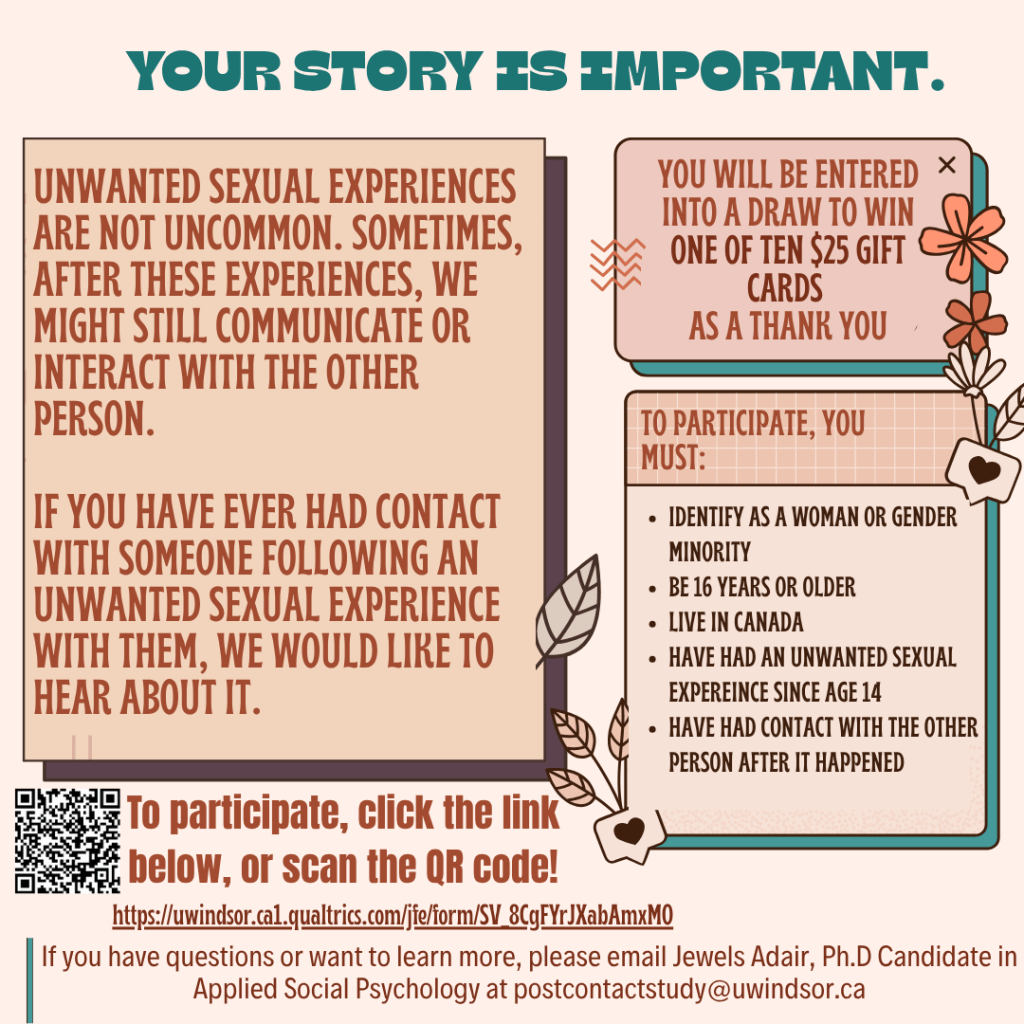
    The purpose of this study is to centre survivors’ voices in an area that has often been overlooked in research, specifically, what happens after an unwanted sexual experience when there is continued interaction with the person involved.

    This study involves both a survey and interview. Once participants fill out the survey, they can indicate if they are interested in participating in a follow-up interview. If they are, we will reach out to them to see if they are still interested, and set up an interview date that works for them.

    In summary, our study seeks to understand what happens after an unwanted sexual experience when individuals have communication or contact with the person involved, specifically from the survivor’s lived experiences. It examines how perpetrators respond in these interactions (e.g., denial, minimization, blame), how survivors interpret and make sense of these responses, and how these interactions affect their well-being.
    We also aim to explore how broader social narratives and power dynamics may shape these interactions, with the goal of developing a more comprehensive and survivor-centred understanding of post-assault experiences.

    Link to Complete the Survey

    Contact:
    Jewels Adair
    University of Windsor
    Sher / Her
    adair3@uwindsor.ca
  • Uncloseted Media looking to interview Canadians aged ~22 and under about Mental Health Support

    Uncloseted Media looking to interview Canadians aged ~22 and under about Mental Health Support

    I’m a reporter with LGBT publication, Uncloseted Media. We are currently working on a story about the mental health challenges faced by Canadian queer youth. I am reaching out here to see if anyone in this group is Canadian, aged around 22 and under, and would be open to speaking with me about your experiences dealing with mental illness. I am hoping to talk about things like: What has your struggle with mental illness looked like? Have you been able to find LGBT-specific supports? Is your community accepting of your identity?


    To participate please email: emma.paidra@unclosetedmedia.com

    Contact:
    Emma Paidra
    Uncloseted Media
    Sher / Her
    emma.paidra@unclosetedmedia.com
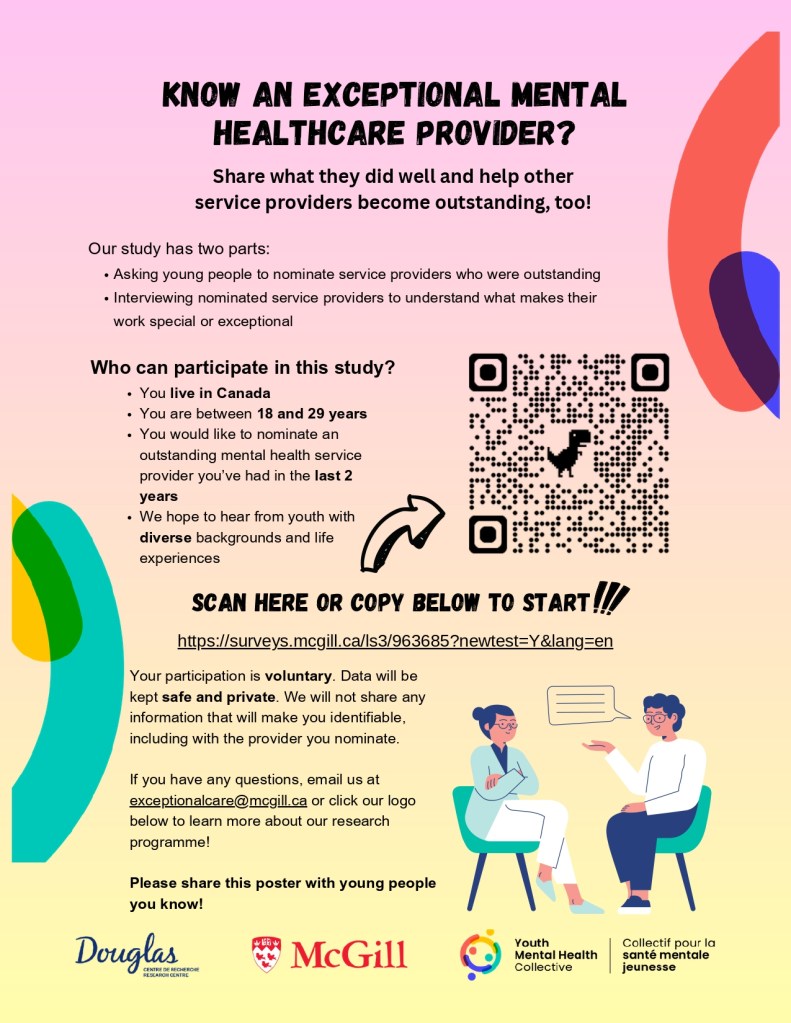
  • What makes mental health care exceptional for queer and trans youth?

    What makes mental health care exceptional for queer and trans youth?


    While there is a growing body of research on trans and queer youth mental health, most studies focus on the problems and challenges that exist. While this work is important, we must not forget that we can also learn from what is already working well, or even exceptionally well!

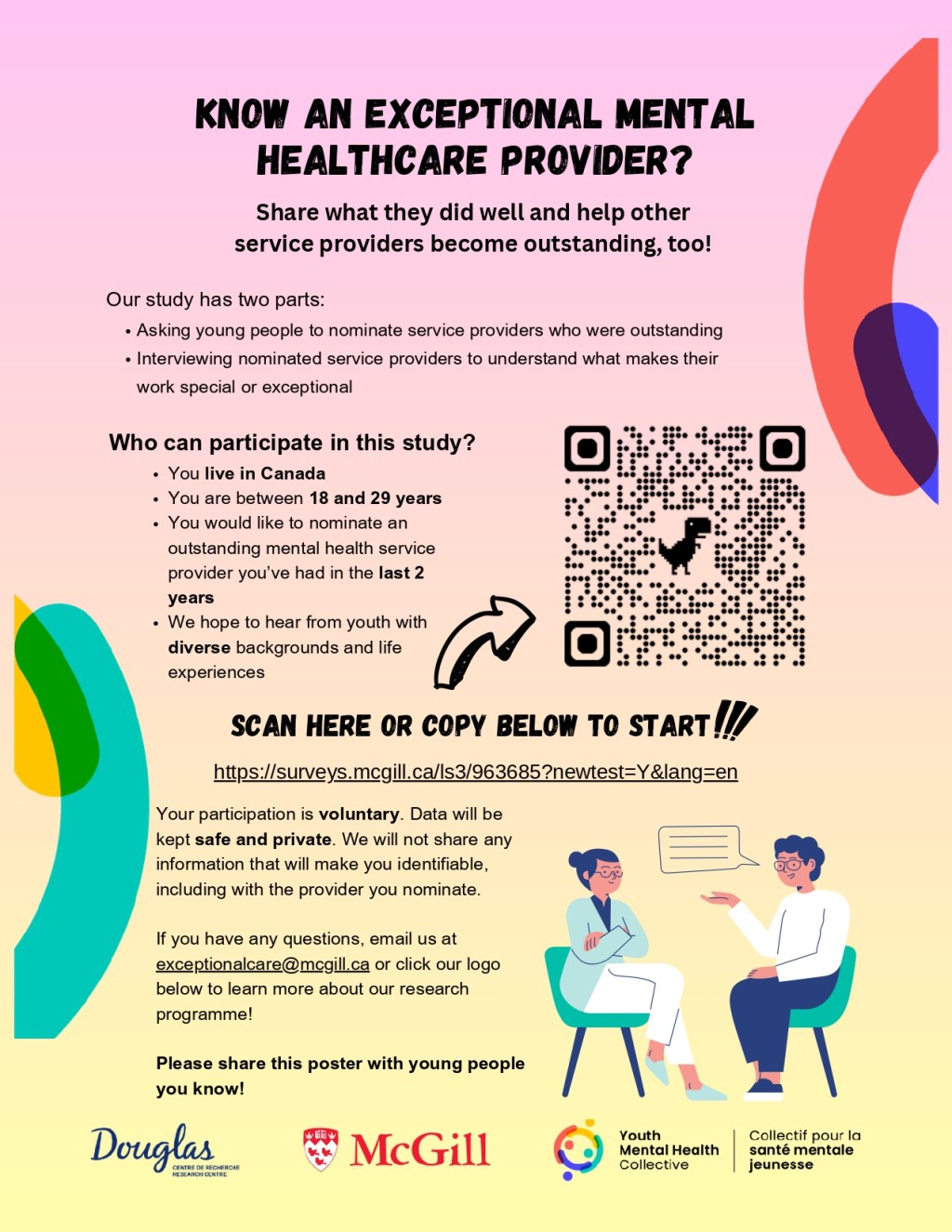
    As a part of a larger project aiming to understand what makes mental health care exceptional for youth, this study is specifically interested in exploring trans and queer youth’s experiences of care that exceeds expectations. We’re asking 2SLGBTQIA+ people (18–29) across Canada to nominate mental health care providers who have offered exceptional, above-and-beyond, or outstanding care. Our goal is to understand the experiences of above-and-beyond care from the perspectives of queer and trans youth, as well as to interview these providers to explore their experiences, approaches, and motivations providing mental health care.

    We believe that young people are best placed to identify these exemplars of care, and we hope to receive nominations from youth from diverse backgrounds, as well as for service providers with diverse qualifications and expertise (therapists, psychologists, social workers, nurses, doctors, guidance counsellors, spiritual leaders, etc.).

    We hope this study accomplishes a few things. 1. Identify which aspects of care are most appreciated by queer and trans youth 2. Disseminate to appropriate interest holders and organizations the approaches and practices that service providers endorse for building relationships with young people 3. Uncover new questions to ask for improving the mental health care services and well-being of queer and trans young people.

    Link to Complete the Survey

    Contact:
    John Bedirian
    McGill Department of Psychiatry
    He / Him
    john.bedirian@mail.mcgill.ca