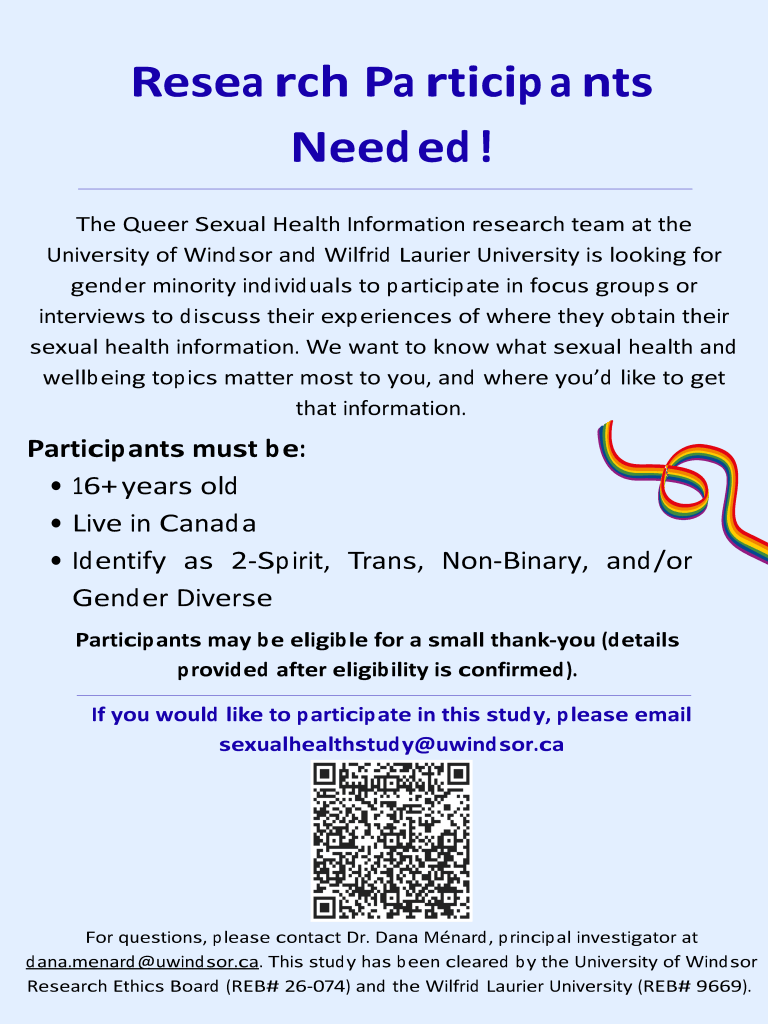
We are recruiting individuals who identify as gender minority group members (e.g., transgender, non-binary, agender) to participate in focus groups or interviews on where they get their sexual health information and what their needs are in relation to their sexual health and wellbeing. The groups or interviews will take 1-2 hours to complete and will be online or in person, depending on participants’ preferences. Topics will include myths and misinformation in the community, current sexual health information needs, and preferred channels for receiving sexual health information.
$50 gift card for participation.
Link to Complete
Please email sexualhealthstudy@uwindsor.ca to participate
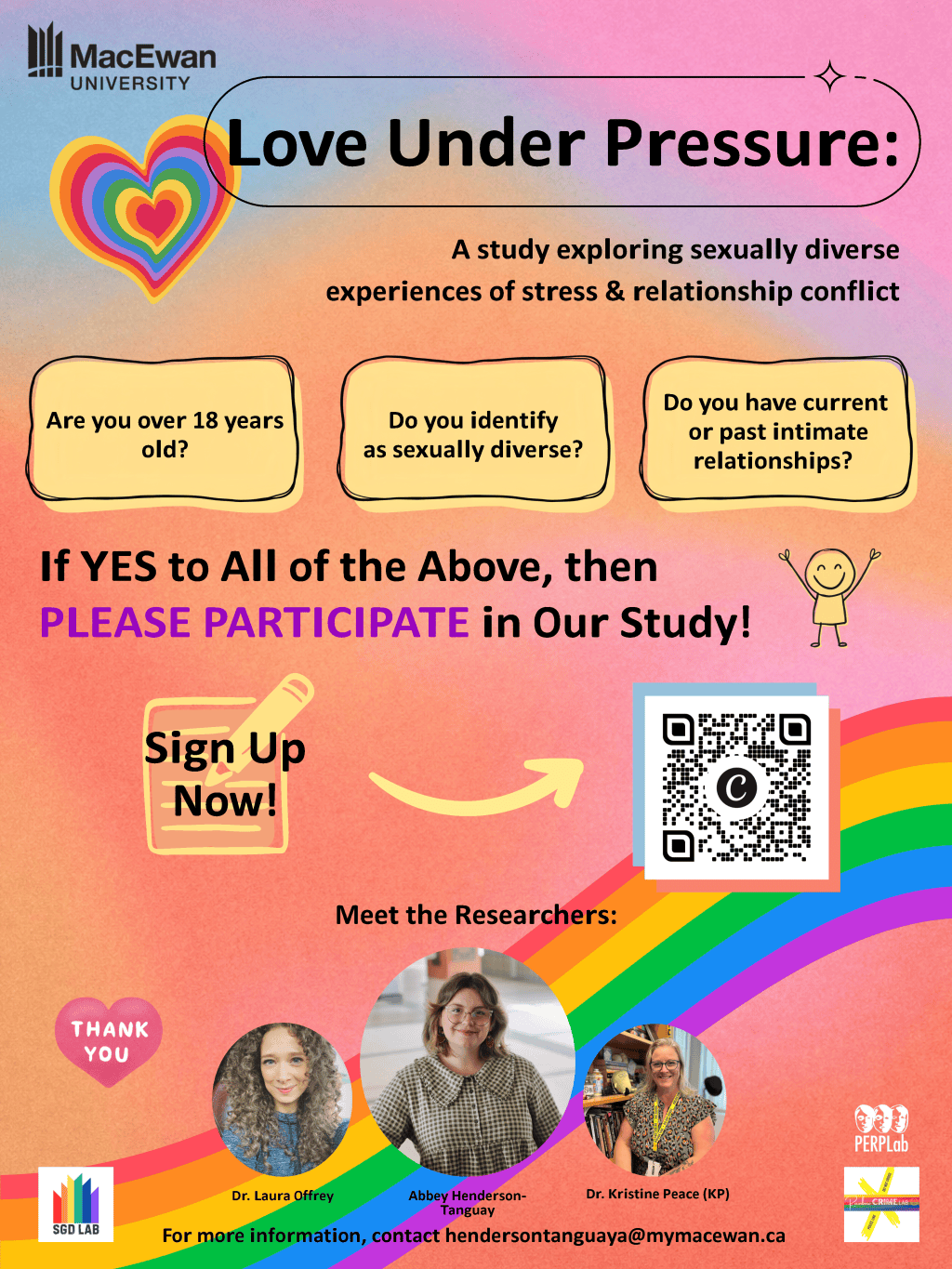
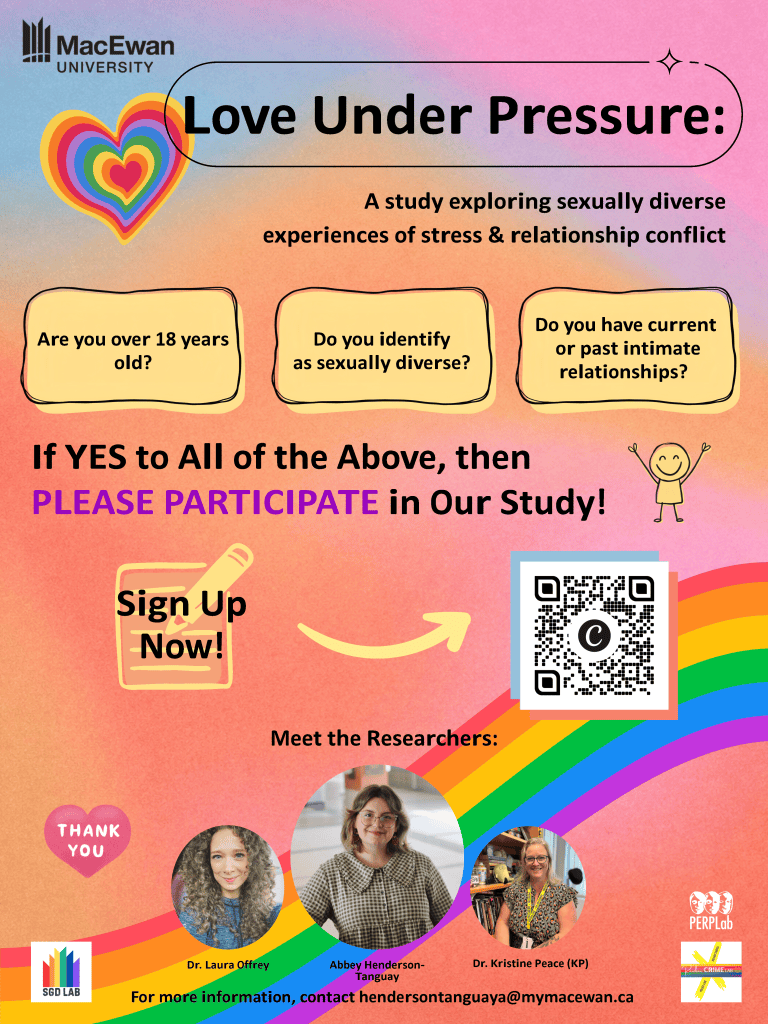
The survey examines specific risk/protective factors that we predict will impact the relationship between sexual minority stress and Intimate Partner Violence outcomes. We hope to gain an inclusive, sexually diverse perspective on how stress impacts relationship health and violence. We are also hoping to gain information on factors that reduce stress and increase relationship health and non-violent behaviours.
We are recruiting individuals who identify as gender minority group members (e.g., transgender, non-binary, agender) to participate in focus groups or interviews on where they get their sexual health information and what their needs are in relation to their sexual health and wellbeing. The focus groups or interviews will take 1-2 hours to complete and will be online or in person, depending on participants’ preferences. Topics will include myths and misinformation in the community, current sexual health information needs, and preferred channels for receiving sexual health information.
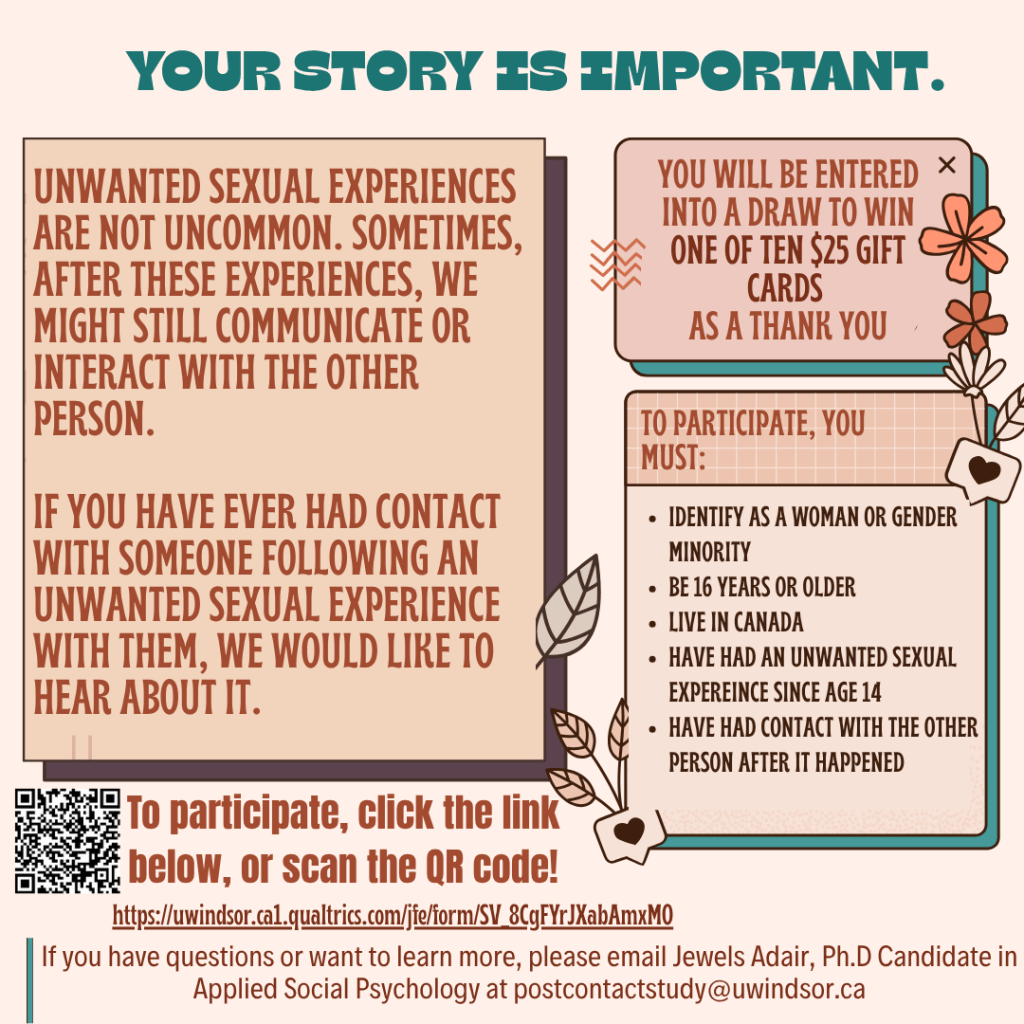
The purpose of this study is to centre survivors’ voices in an area that has often been overlooked in research, specifically, what happens after an unwanted sexual experience when there is continued interaction with the person involved.
This study involves both a survey and interview. Once participants fill out the survey, they can indicate if they are interested in participating in a follow-up interview. If they are, we will reach out to them to see if they are still interested, and set up an interview date that works for them.
In summary, our study seeks to understand what happens after an unwanted sexual experience when individuals have communication or contact with the person involved, specifically from the survivor’s lived experiences. It examines how perpetrators respond in these interactions (e.g., denial, minimization, blame), how survivors interpret and make sense of these responses, and how these interactions affect their well-being. We also aim to explore how broader social narratives and power dynamics may shape these interactions, with the goal of developing a more comprehensive and survivor-centred understanding of post-assault experiences.
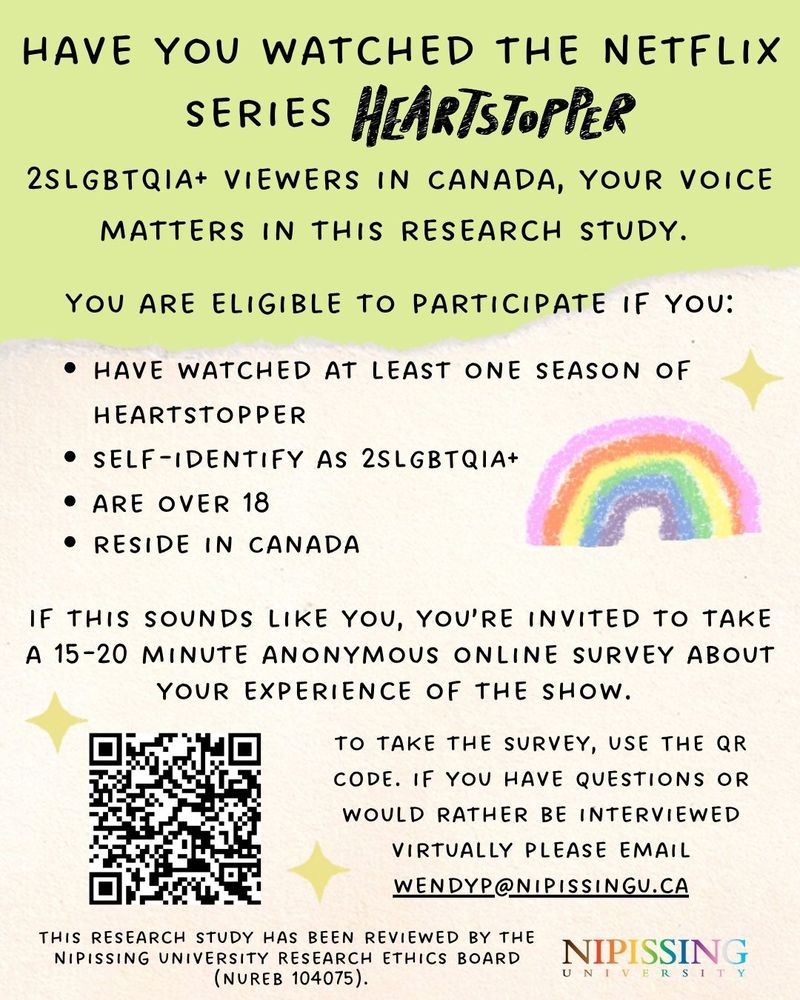
Have you watched Netflix’s Heartstopper? Whether you binged all three seasons in a weekend, search daily for the release date of the feature-length film that will conclude the series, or just checked out a season out of curiosity, your experience matters.
Dr. Wendy Peters, a researcher at Nipissing University, is seeking 2SLGBTQIA+ viewers across Canada to participate in a study exploring how we connect with Heartstopper—a series that centres on the lives of lesbian, gay, bisexual, trans, non-binary, and asexual characters.
The research, titled “Tender TV in Turbulent Times: 2SLGBTQIA+ Viewers and Their Relationship to Netflix’s Heartstopper,” examines how queer audiences watch, interpret, and make meaning from the series. How did you discover the show? Do you watch alone or with others? Does it resonate with your own experiences, or does it feel distant from your reality? How did the TV series Heartstopper land in the context of your life?
You don’t need to be a fan to participate—you just need to have watched at least one season and be willing to share your thoughts.
You’re eligible if you: • Have watched at least one season of Heartstopper • Self-identify as 2SLGBTQIA+ • Are over 18 and live in Canada
Participation involves a 10-15 minute anonymous online survey. The study is seeking up to 85 participants.
This survey specifically asks about experiences with Montreal’s GRS clinic. If you had surgery at a clinic other than the GRS, please do not fill out this survey; however, we would be happy to interview you about your experience!
You are eligible to take this survey if you are at least 3 months post-op.
Data usage
Our goal for this survey is to collect data people’s experience at GRS, and to use this information to advocate for better practices at GRS and associated medical organizations. All submissions are kept strictly confidential, but information from your submissions will be used internally by the TPU and may be included in aggregate statistics discussed with GRS and other organizations (e.g. 50% of patients reported being misgendered).