Tag: Transgender Health

  • What makes mental health care exceptional for queer and trans youth?

    What makes mental health care exceptional for queer and trans youth?


    While there is a growing body of research on trans and queer youth mental health, most studies focus on the problems and challenges that exist. While this work is important, we must not forget that we can also learn from what is already working well, or even exceptionally well!

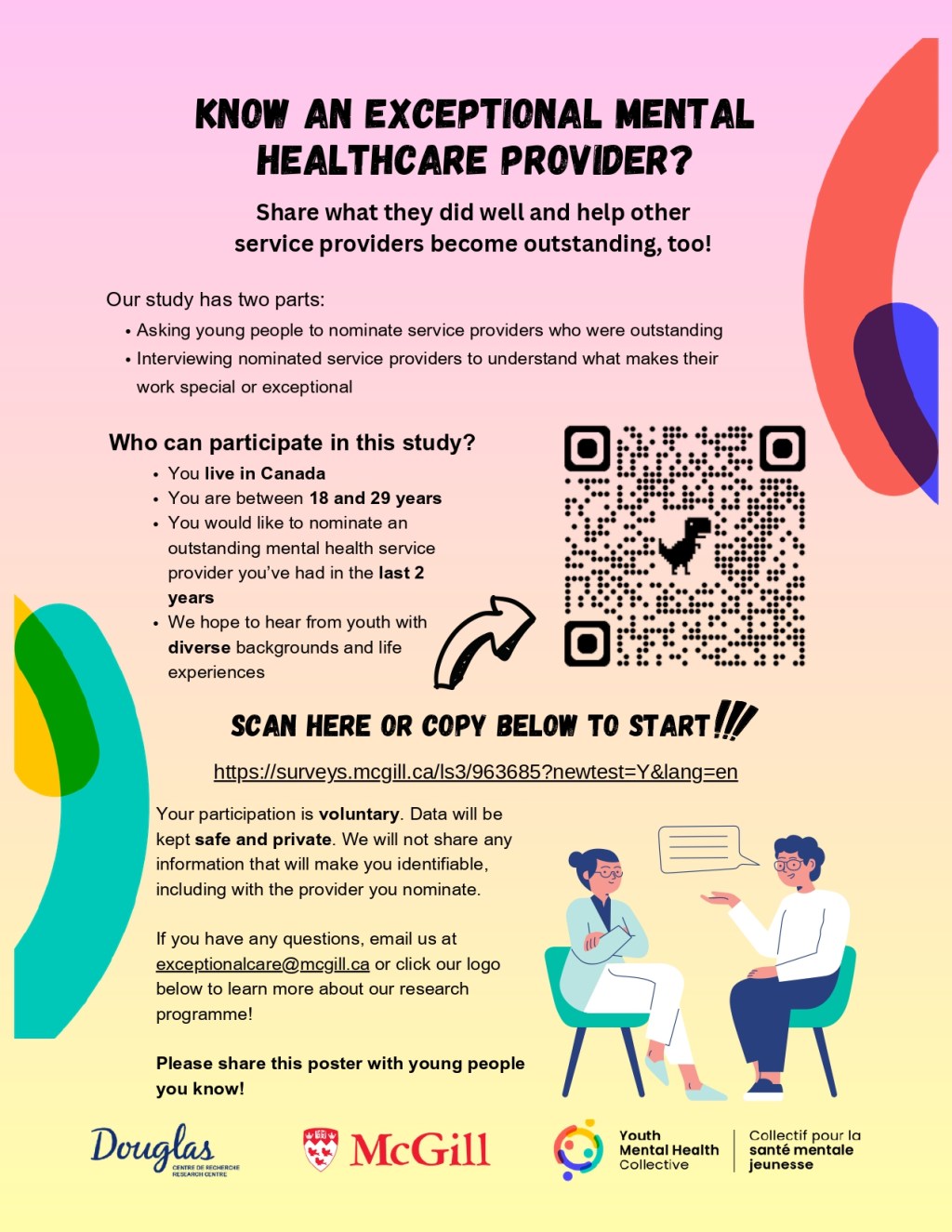
    As a part of a larger project aiming to understand what makes mental health care exceptional for youth, this study is specifically interested in exploring trans and queer youth’s experiences of care that exceeds expectations. We’re asking 2SLGBTQIA+ people (18–29) across Canada to nominate mental health care providers who have offered exceptional, above-and-beyond, or outstanding care. Our goal is to understand the experiences of above-and-beyond care from the perspectives of queer and trans youth, as well as to interview these providers to explore their experiences, approaches, and motivations providing mental health care.

    We believe that young people are best placed to identify these exemplars of care, and we hope to receive nominations from youth from diverse backgrounds, as well as for service providers with diverse qualifications and expertise (therapists, psychologists, social workers, nurses, doctors, guidance counsellors, spiritual leaders, etc.).

    We hope this study accomplishes a few things. 1. Identify which aspects of care are most appreciated by queer and trans youth 2. Disseminate to appropriate interest holders and organizations the approaches and practices that service providers endorse for building relationships with young people 3. Uncover new questions to ask for improving the mental health care services and well-being of queer and trans young people.

    Link to Complete the Survey

    Contact:
    John Bedirian
    McGill Department of Psychiatry
    He / Him
    john.bedirian@mail.mcgill.ca
  • Developing the knowledge to improve access to inclusive and equitable care for trans and gender diverse survivors of gender-based violence

    Developing the knowledge to improve access to inclusive and equitable care for trans and gender diverse survivors of gender-based violence

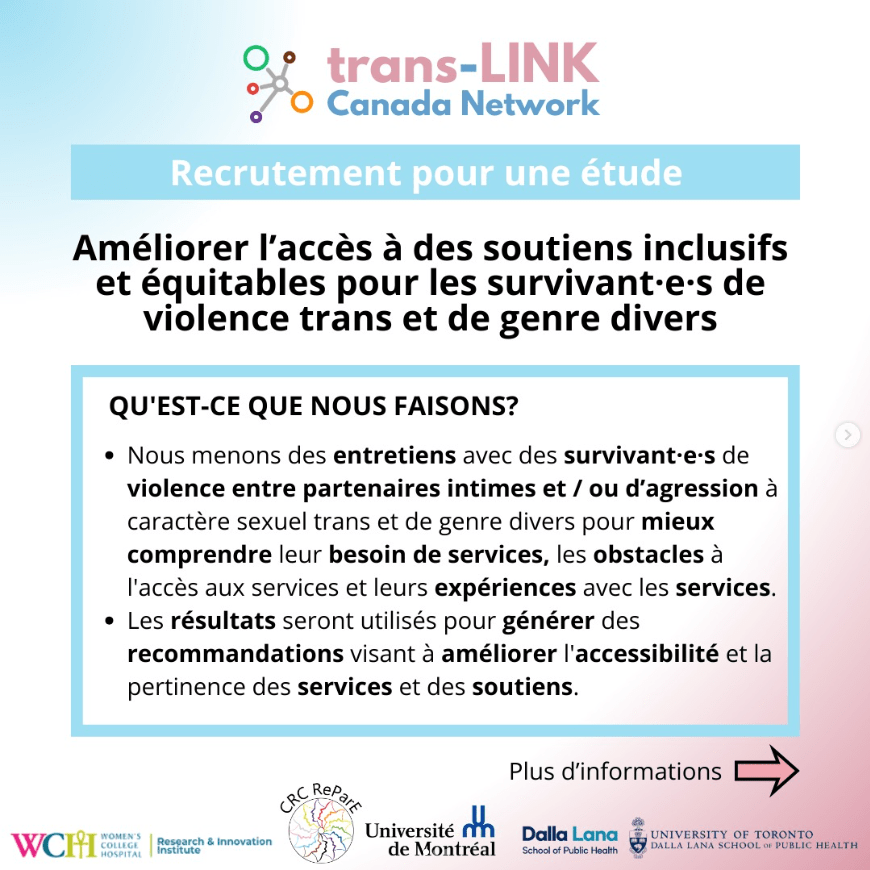
    Our objective is to better understand trans and gender diverse youth’s needs, obstacles to access, and lived experiences with services in regard to the violence they faced with intimate partners or sexual assault. The results of this research project will help us formulate recommendations as well as create educational resources destined to service providers of different sectors (ex.: health, residence, justice, etc.).
    Participants have to identify as a trans/ gender diverse person, have survived intimate partner violence and/or sexual assault, reside in Canada, be 19 and up, have considered contacting, tried to access or have accessed services, whether they be linked or not to intimate partner violence and/or sexual assault, and need to be able to communicate in French. This research will be examined by the research ethics committee of Women’s college hospital (2023-0033-E) and of the University of Montreal (2025-7321). 


    Participant registration by email: crcrepare-translink@esersoc.umontreal.ca

    https://www.instagram.com/p/DUBX080j6O7/?img_index=1
  • Trans Patient Union – Vaginoplasty Survey

    Trans Patient Union – Vaginoplasty Survey

    GRS Vaginoplasty Survey

    This survey specifically asks about experiences with Montreal’s GRS clinic. If you had surgery at a clinic other than the GRS, please do not fill out this survey; however, we would be happy to interview you about your experience!

    You are eligible to take this survey if you are at least 3 months post-op.

    Data usage

    Our goal for this survey is to collect data people’s experience at GRS, and to use this information to advocate for better practices at GRS and associated medical organizations. All submissions are kept strictly confidential, but information from your submissions will be used internally by the TPU and may be included in aggregate statistics discussed with GRS and other organizations (e.g. 50% of patients reported being misgendered).