Tag: Interviews

  • Sexual health information needs and preferred communication channels for sexual and gender minority group members

    Sexual health information needs and preferred communication channels for sexual and gender minority group members

    About the Research

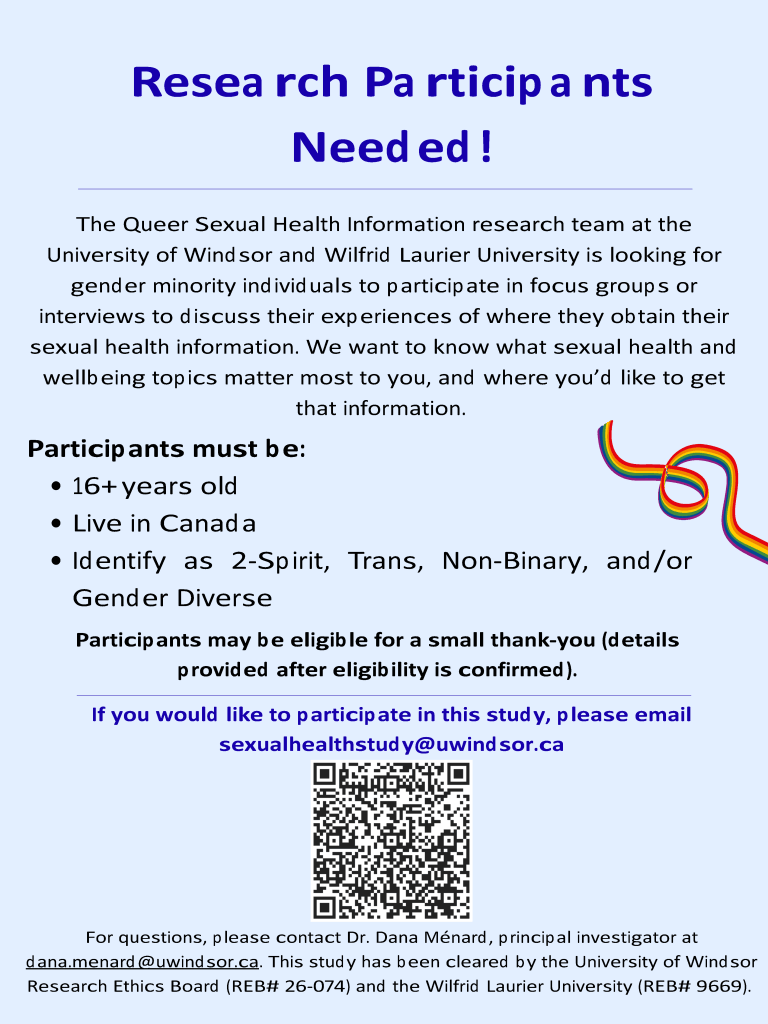
    We are recruiting individuals who identify as gender minority group members (e.g., transgender, non-binary, agender) to participate in focus groups or interviews on where they get their sexual health information and what their needs are in relation to their sexual health and wellbeing. The groups or interviews will take 1-2 hours to complete and will be online or in person, depending on participants’ preferences. Topics will include myths and misinformation in the community, current sexual health information needs, and preferred channels for receiving sexual health information.

    $50 gift card for participation.
    Please email sexualhealthstudy@uwindsor.ca to participate

    Researcher Contact

    Sophia D’Alonzo – She/Her
    Menard Psych Group

    Poster

  • Nonbinary Lives: Experiences of Genderism within Intimate Relationships

    Nonbinary Lives: Experiences of Genderism within Intimate Relationships

    Nonbinary Lives: Experiences of Genderism within Intimate Relationships

    About the Research

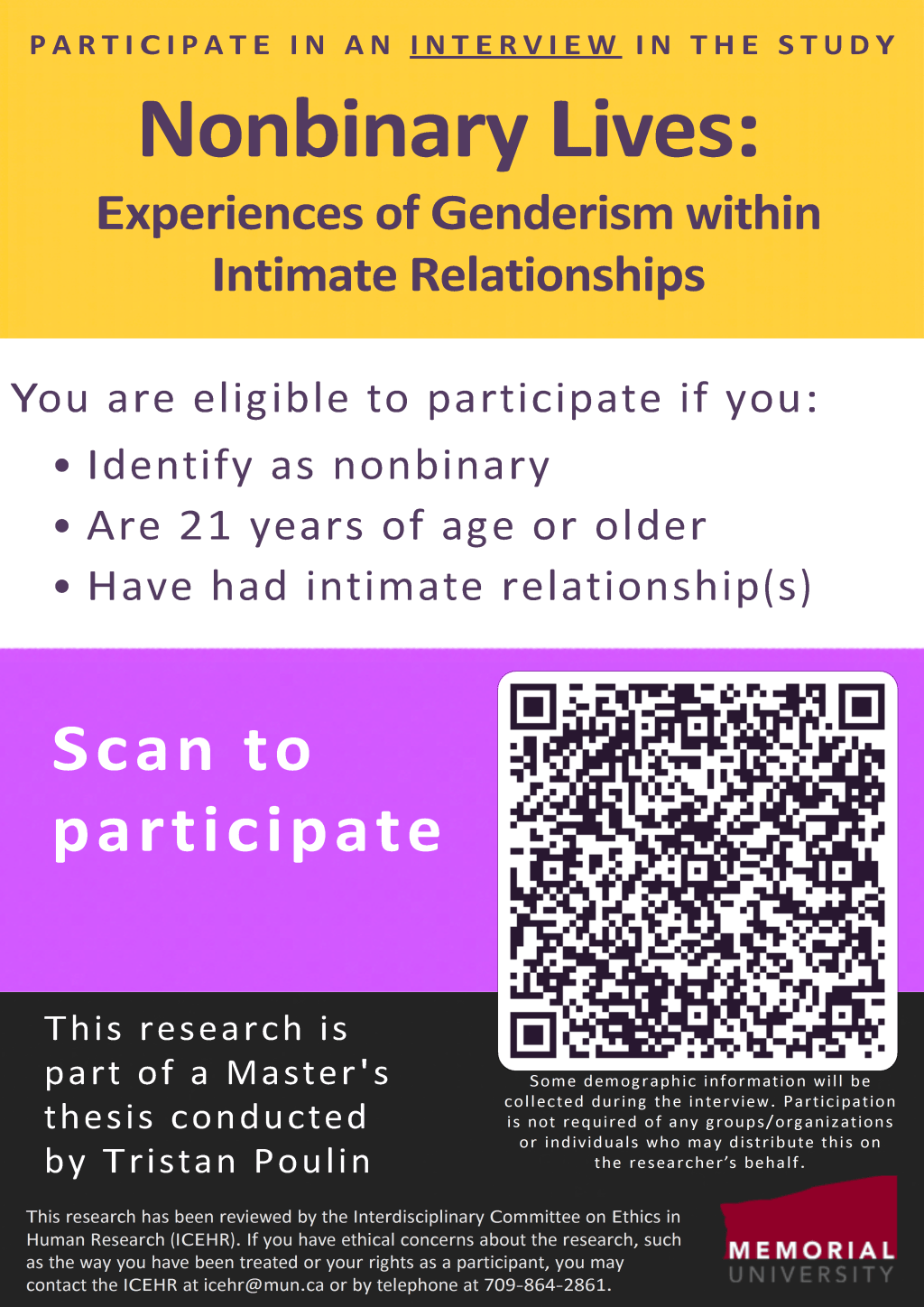
    The purpose of the study is to examine how nonbinary individuals navigate and negotiate binary gender norms within intimate relationships. You are invited to participate in an interview in which you will be asked to answer questions about your experience of rigid binary gender norms as a nonbinary person.
    https://forms.gle/7HNuBSUWN9GxEqmh6

    Researcher Contact

    Tristan Poulin – They/Them
    Memorial University of Newfoundland
    tpoulin@mun.ca

    Poster

  • Sexual health information needs and preferred communication channels for sexual and gender minority group members

    Sexual health information needs and preferred communication channels for sexual and gender minority group members

    1. About the Research
    2. Link to Complete
    3. Researcher Contact
    4. Poster

    About the Research

    We are recruiting individuals who identify as gender minority group members (e.g., transgender, non-binary, agender) to participate in focus groups or interviews on where they get their sexual health information and what their needs are in relation to their sexual health and wellbeing. The focus groups or interviews will take 1-2 hours to complete and will be online or in person, depending on participants’ preferences. Topics will include myths and misinformation in the community, current sexual health information needs, and preferred channels for receiving sexual health information.

    Please email sexualhealthstudy@uwindsor.ca

    Researcher Contact

    Sophia D’Alonzo – She / Her
    The queer Sexual Health Information team sexualhealthstudy@uwindsor.ca

  • How to include gender diversity in quantitative research : how gender categories are produced and received

    How to include gender diversity in quantitative research : how gender categories are produced and received

    1. About the Research
    2. Link to Complete
    3. Researcher Contact
    4. Poster

    About the Research

    ⟶ What is my research about?

    My name is Marie (he/they), and I’m pursuing a PhD in France (EHESS) and in Quebec (UQAM). My thesis focuses on how research addresses the specific experiences of non-binary people. To that end, I’m conducting interviews with people who do not identify within binary gender categories.

    ⟶ Who can participate?

    Anyone living in Quebec who identifies on the non-binary spectrum—including people who are genderfluid, genderqueer, trans non-binary, Two-Spirit, agender… or who refuse to categorize their gender.

    ⟶ What in an interview?

    It’s a meeting—either remotely or at a location of your choice in Montreal (I know a few great places)—to chat for one to two hours about the terms you use, your relationship to gender, and the role of labels. Drinks are on me!

    The interviews are recorded using a voice recorder. They are anonymized and confidential. I use consent forms.

    ⟶ What’s the purpose?

    My work aims to improve the representation of trans and non-binary people in research, in order to implement public policies that are truly useful for our communities. In France, I hope to help improve survey questionnaires. In the Quebec context, I want to help develop analytical techniques that truly shed light on the realities and needs of trans and non-binary people.

    instagram : @recherche_nonbinarite

    Researcher Contact

    Marie Delahousse – They / Them
    marie.delahousse@ehess.fr
    10/23/2026

  • Piloting a brief, online intervention for suicidality in sexual and gender minority youth

    Piloting a brief, online intervention for suicidality in sexual and gender minority youth

    1. About the Research
    2. Link to Complete
    3. Researcher Contact
    4. Poster

    About the Research

    You are being invited to participate in a study investigating the effectiveness and acceptability of KindMind, an online program designed to help reduce suicidal thoughts in sexual and gender minority youth. In this study, you will be asked to complete an initial study session that will involve filling out questionnaires on mental health symptoms, such as depressive symptoms and suicidal thoughts and behaviours, and completing KindMind, a 20-minute online program. This session should take approximately 40 minutes. One month after this initial session, you will be asked to complete a follow-up survey that will take approximately 5-10 minutes. Your participation is completely voluntary, and all information collected is confidential.

    https://uwo.eu.qualtrics.com/jfe/form/SV_820F4Cgv34EXBv8

    Researcher Contact

    Genny Bianchini

    She / Her
    gbianch2@uwo.ca

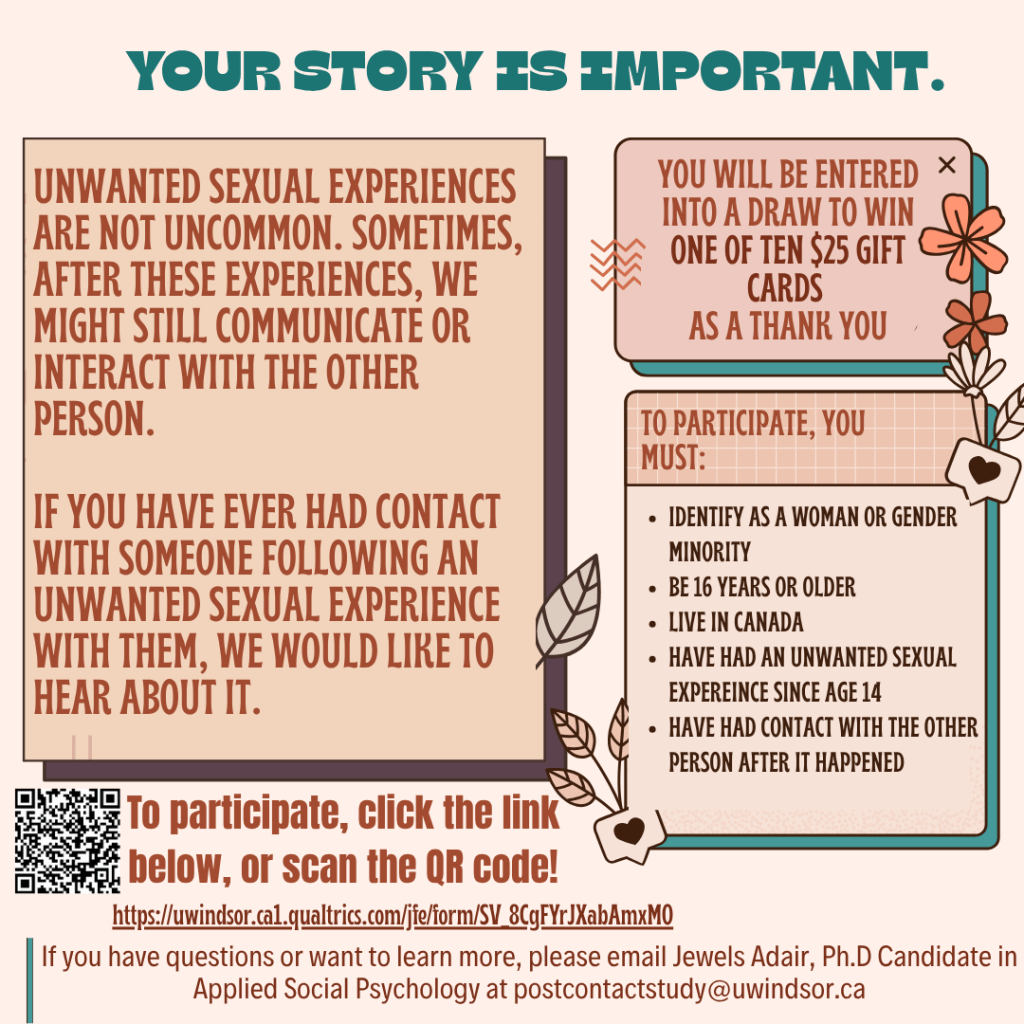
  • A Study Exploring Experiences of Contact Following Unwanted Sexual Experiences

    A Study Exploring Experiences of Contact Following Unwanted Sexual Experiences

    The purpose of this study is to centre survivors’ voices in an area that has often been overlooked in research, specifically, what happens after an unwanted sexual experience when there is continued interaction with the person involved.

    This study involves both a survey and interview. Once participants fill out the survey, they can indicate if they are interested in participating in a follow-up interview. If they are, we will reach out to them to see if they are still interested, and set up an interview date that works for them.

    In summary, our study seeks to understand what happens after an unwanted sexual experience when individuals have communication or contact with the person involved, specifically from the survivor’s lived experiences. It examines how perpetrators respond in these interactions (e.g., denial, minimization, blame), how survivors interpret and make sense of these responses, and how these interactions affect their well-being.
    We also aim to explore how broader social narratives and power dynamics may shape these interactions, with the goal of developing a more comprehensive and survivor-centred understanding of post-assault experiences.

    Link to Complete the Survey

    Contact:
    Jewels Adair
    University of Windsor
    Sher / Her
    adair3@uwindsor.ca
  • Uncloseted Media looking to interview Canadians aged ~22 and under about Mental Health Support

    Uncloseted Media looking to interview Canadians aged ~22 and under about Mental Health Support

    I’m a reporter with LGBT publication, Uncloseted Media. We are currently working on a story about the mental health challenges faced by Canadian queer youth. I am reaching out here to see if anyone in this group is Canadian, aged around 22 and under, and would be open to speaking with me about your experiences dealing with mental illness. I am hoping to talk about things like: What has your struggle with mental illness looked like? Have you been able to find LGBT-specific supports? Is your community accepting of your identity?


    To participate please email: emma.paidra@unclosetedmedia.com

    Contact:
    Emma Paidra
    Uncloseted Media
    Sher / Her
    emma.paidra@unclosetedmedia.com
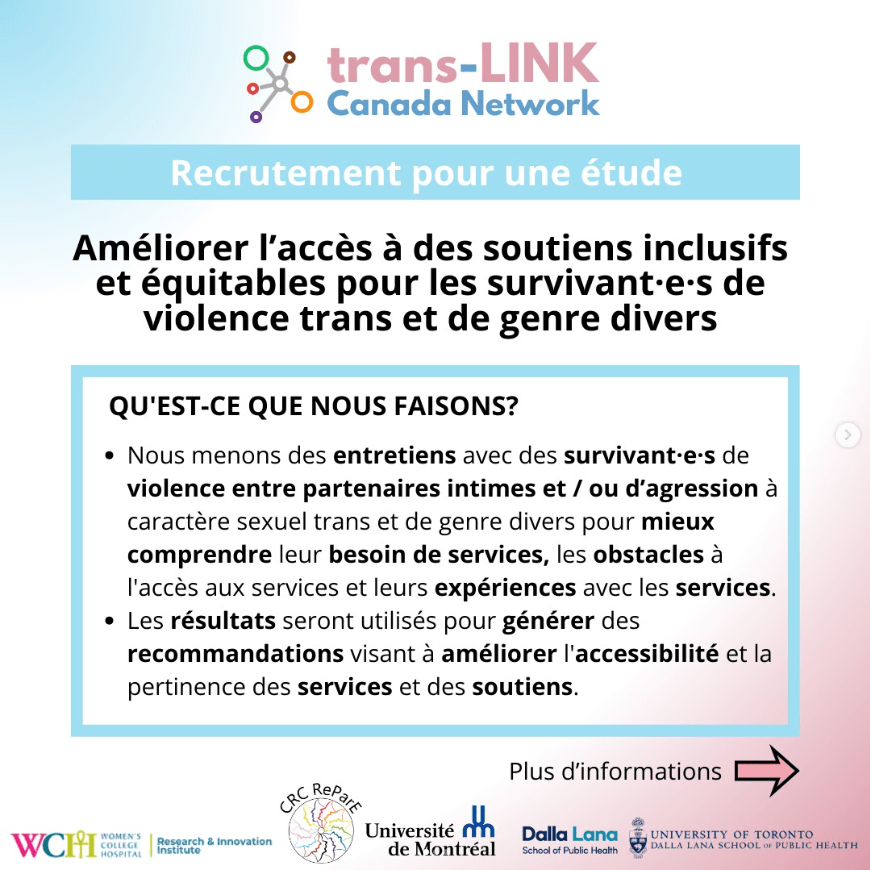
  • Developing the knowledge to improve access to inclusive and equitable care for trans and gender diverse survivors of gender-based violence

    Developing the knowledge to improve access to inclusive and equitable care for trans and gender diverse survivors of gender-based violence

    Our objective is to better understand trans and gender diverse youth’s needs, obstacles to access, and lived experiences with services in regard to the violence they faced with intimate partners or sexual assault. The results of this research project will help us formulate recommendations as well as create educational resources destined to service providers of different sectors (ex.: health, residence, justice, etc.).
    Participants have to identify as a trans/ gender diverse person, have survived intimate partner violence and/or sexual assault, reside in Canada, be 19 and up, have considered contacting, tried to access or have accessed services, whether they be linked or not to intimate partner violence and/or sexual assault, and need to be able to communicate in French. This research will be examined by the research ethics committee of Women’s college hospital (2023-0033-E) and of the University of Montreal (2025-7321). 


    Participant registration by email: crcrepare-translink@esersoc.umontreal.ca

    https://www.instagram.com/p/DUBX080j6O7/?img_index=1
  • Queering Waste: The Commodification of Queer Identity and the Disposability of Queer People – Call for Participants

    Queering Waste: The Commodification of Queer Identity and the Disposability of Queer People – Call for Participants

    I am inviting full-time students enrolled at Queen’s University or Concordia University to take part in a research study.
    The purpose of this study is to see how queer individuals understand their identity as it relates to consumption.

    If you agree to take part, I will interview you for approximately one hour at a public location you choose OR via Zoom. The interview will be audio-recorded by phone recorder or by Zoom software (if virtual) and later transcribed.

    There is a risk that some of the questions may upset you emotionally, cover sensitive or personal issues, or bring up culturally sensitive
    topics. If you feel upset after the interview, please call the Telephone Aid Line Kingston (TALK) at 613-544-1771, Ontario’s LGBTQ2+ Youthline at 1-800-268-9688 or Québec’s Interligne at 1-888-505-1010.

    There are no direct benefits to you as a participant. Study results may help guide queer university students to more effectively combat
    marginalization. You will not be paid for taking part in this study.